
Search Everywhere Optimization: Why Multi-Platform SEO Matters Now
By the My Marketing World Editorial Team
You are reviewing next quarter’s SEO budget. Google Ads is performing. Your blog ranks for priority keywords. But your analytics show something unsettling: younger visitors arrive from TikTok, product inquiries mention “saw it on YouTube,” and your competitor launched a ChatGPT-optimized FAQ. The question is no longer whether Google matters — it does. The question is whether Google alone is enough.
It is not.
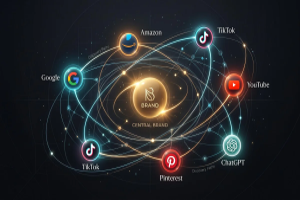
Research from Michigan Technological University describes the shift from Search Engine Optimization to Search Everywhere Optimization — optimizing brand content for discovery across every platform where consumers search. Google’s data confirms nearly 40% of Gen Z prefer TikTok and Instagram over Google for certain queries. Search behavior is fragmenting, and brands that adapt will own the coming decade.
The Search Landscape Has Already Fragmented
Consumers no longer follow a single path. A shopper might check TikTok for unboxing videos, Amazon for verified purchases, YouTube for comparisons, and only then run a Google search — if at all.
Adobe’s 2026 survey found 49% of US consumers have used TikTok as a search engine, up from 41% in 2024. Northwestern University’s Retail Analytics Council reports 45.9% of adults are aware of generative AI, with 26% actively using ChatGPT and Copilot for research. AI assistants are now a genuine search alternative.
This is not a future trend. It is behavior happening now.
What Search Everywhere Optimization Actually Means
Multi-platform SEO is not about reposting content everywhere. Each platform has distinct ranking logic. TikTok prioritizes watch time and keyword relevance in captions. Amazon’s A9 engine weighs review velocity. YouTube factors click-through rate and session duration. ChatGPT relies on semantic relevance and structured data. An AI-driven marketing strategy that wins Google snippets needs different formatting to surface in ChatGPT responses.
The Platform Discovery Audit
To find where your brand shows up — and where it disappears — rate each platform 0 to 3:
#
Discovery Platform
Score
Priority Action
1
Google (Organic)
☐ 0 ☐ 1 ☐ 2 ☐ 3
Core keyword rankings
2
Google (Local/Maps)
☐ 0 ☐ 1 ☐ 2 ☐ 3
GBP completeness
3
TikTok
☐ 0 ☐ 1 ☐ 2 ☐ 3
Keyword-rich captions
4
YouTube
☐ 0 ☐ 1 ☐ 2 ☐ 3
Title/description SEO
5
Amazon
☐ 0 ☐ 1 ☐ 2 ☐ 3
A9 compliance, reviews
6
☐ 0 ☐ 1 ☐ 2 ☐ 3
Image SEO, boards
7
☐ 0 ☐ 1 ☐ 2 ☐ 3
Searchable captions
8
☐ 0 ☐ 1 ☐ 2 ☐ 3
Community presence
9
ChatGPT / AI Engines
☐ 0 ☐ 1 ☐ 2 ☐ 3
Structured data
10
Bing / Copilot
☐ 0 ☐ 1 ☐ 2 ☐ 3
Microsoft ecosystem
11
App Stores
☐ 0 ☐ 1 ☐ 2 ☐ 3
App store metadata
Scoring: 0–8 = significant gaps; 9–17 = moderate visibility; 18–27 = strong presence; 28–33 = discovery leadership.
Local SEO success stories show brands scoring 18+ capture 2–3x more organic touchpoints than Google-only competitors.
The Trust Gap
The Nuremberg Institute for Market Decisions surveyed 1,000 consumers each in the US, UK, and Germany, finding only 21% trust AI companies and 20% trust AI itself. When identical ads were labeled “AI-generated,” consumers rated them as less natural and were less willing to buy. Multi-platform optimization must be paired with transparency. AI marketing for local businesses works best when disclosure is honest. Northwestern’s Council reinforces this: 55% are very concerned about AI privacy risks.
Where This Advice Has Limits
If your audience is over 55 and regionally concentrated, Google likely dominates. B2B brands may find LinkedIn outperforms TikTok. Budget constraints matter — a small business visible on eleven platforms often ends up invisible on all. The audit exposes gaps; it does not mandate presence everywhere. Start with three platforms where your audience already searches.
What to Do Next Week
- Run the Platform Discovery Audit
- Identify your top three platforms via audience research.
- Audit one content piece per platform for native optimization.
- Review structured data so AI engines can cite your content.
The shift to multi-platform discovery is measurable in your traffic sources. Brands treating every platform as a search engine get found.
Frequently Asked Questions
Should we stop investing in Google SEO? No. Google holds 85%+ share in most European markets. Expand your strategy, don’t abandon it. Protect rankings, then allocate 20–30% of search resources to emerging platforms.
Which platform first after Google? Consumer brands under-35: TikTok. E-commerce: Amazon. B2B: YouTube and LinkedIn. Use the audit to find your biggest gap, not the trendiest platform.
How is ChatGPT optimization different? AI engines synthesize answers from sources rather than ranking pages. Optimization requires clear question-answering content and schema markup. AI marketing agency approaches focusing on semantic authority perform best.
How long until results? TikTok: hours. YouTube: 2–4 months. Amazon: depends on sales velocity. AI citations: gradual. Expect 6–12 months for meaningful traction.
Small team — can we do this? Focus on two or three platforms. Repurpose one product video for TikTok (short-form), YouTube (annotated), and your site (embedded with transcript). This focused approach to discovery optimization beats mediocrity on many platforms.
Research and Practical Sources
- Michigan Technological University — research on Search Everywhere Optimization and platform-native discovery strategies.
- Northwestern University Retail Analytics Council / Prosper Technologies — “Generative Artificial Intelligence and Consumer Trends in Awareness, Usage and Trust” (December 2024, n=7,861).
- Nuremberg Institute for Market Decisions (NIM) — “Consumer Attitudes Toward AI-Generated Marketing Content,” Buder et al. (2024), cross-national experiments (US/UK/Germany, n=1,000 per market).
- Adobe Express — “Using TikTok as a Search Engine” (2026), consumer survey (n=807 US consumers, 200 small business owners).
- AI-driven marketing trends — Marketing First Media
- 2026 digital marketing revolution — Progame
- Local SEO success stories — Jungle Gym Magazine
- AI marketing for local businesses — Buen Negocio
- AI marketing agency approaches — SEO Agentur Zürich